The Grid Behind the Pedestal
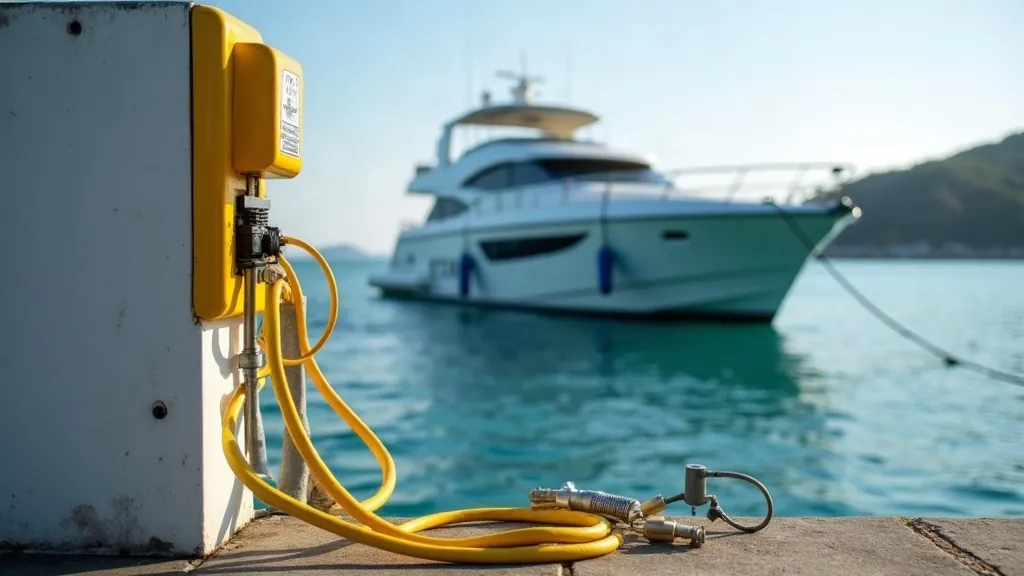
Indonesia runs a 230-volt, 50-hertz grid, and everything at the Labuan Bajo waterfront hangs off it. Dockside pedestals and distribution boards therefore serve 230V single-phase as the default, with 16-amp connections covering smaller cruisers and 32-amp feeds for vessels with real hotel loads. Genuine three-phase 400V supply for large superyachts exists only in limited positions and is arranged case by case with the marina office — if your vessel needs it, raise it at the berth-request stage, not on arrival. Supply stability has improved markedly as the town’s infrastructure has grown, but voltage dips during town-wide evening peaks still happen, which is why most phinisi keep chargers and inverters between the pedestal and anything delicate. We track these standards as independent consultants; verify the specific pier’s capacity when booking.
Plugs, Adapters, and What to Carry
The connector landscape is practical rather than standardised. CEE-form industrial connectors (the blue 16A and 32A rounds familiar from marinas worldwide) are the most common interface, but crews still encounter local industrial sockets and hard-wired distribution boards on older piers, where the working answer is a marina electrician making up a tail. The rule for Eastern Indonesia: carry your own shore cable in good condition, a 16A-to-32A pigtail, a CEE-to-local adapter, and a polarity tester, and assume nothing about the far end until you have metered it. A vessel wired for North American 110–120V/60Hz needs its isolation transformer or converter running — the grid will not meet you halfway, and 50Hz on 60Hz motors shortens their lives.
Before You Energise: the Five-Minute Ritual
Experienced crews treat every new pedestal the same way. Meter the socket: confirm 230V nominal, confirm 50Hz, confirm earth continuity, and check polarity. Inspect the pedestal’s breaker rating and condition — corrosion is the tropical constant. Connect with the vessel’s breaker off, energise ashore first, then bring the boat online and watch the incoming voltage under load. Five minutes of ritual prevents the two classic Labuan Bajo shore-power incidents: a reversed-polarity supply finding a poorly isolated appliance, and a tired pedestal breaker that holds at 20 amps until your air-conditioning compressors all start together at midnight.
Shore-power kit worth carrying in Eastern Indonesia:
- Own shore cable, inspected, with strain relief at both ends.
- 16A and 32A CEE pigtails plus a CEE-to-local-socket adapter.
- Plug-in polarity and earth tester, and a clamp meter aboard.
- Isolation transformer or converter for 110-120V/60Hz vessels.
- Log book column for pedestal meter readings on metered stays.
Managing Load Like a Local
Alongside power here is best treated as a finite ration rather than an infinite tap. A 32A single-phase feed delivers roughly 7 kW — enough for charging, refrigeration, lighting, and one or two air-conditioning zones, but not a full hotel load with watermaker and laundry running. Charter phinisi on turnarounds run a load plan: batteries and refrigeration on shore power continuously, heavy loads sequenced, generator taking the guest-day peaks. Metering on longer stays is increasingly standard, billed per kilowatt-hour on top of berthing fees, so the load plan also controls the invoice — the pricing guide explains how utilities sit alongside berth rates. If your consumption profile is heavy, say so when requesting the berth so the office assigns a position with capacity to match.
When Shore Power Is Not Enough
Some vessels simply out-consume the pier. Superyachts with 60Hz-only systems, dive support boats running compressors, and boats mid-refit with welding sets all end up blending shore supply with generator hours, and the arithmetic usually still favours taking whatever the dock provides for base loads. If you are weighing a berth against staying on a mooring where the generator runs regardless, our cost-logic comparison for Komodo operators works through the fuel-versus-berth trade in USD terms. And wherever you plug in, log your hours and meter readings — billing queries at departure are far easier with your own numbers in hand.
Larger visitors bring their own power questions — see what superyacht calls at Labuan Bajo typically require alongside.
Frequently Asked Questions
What voltage is shore power in Labuan Bajo?
230V single-phase at 50Hz, the Indonesian grid standard. Common dockside connections are 16A and 32A CEE-form; limited three-phase 400V positions for superyachts are arranged case by case with the office.
Can a US-wired 110V/60Hz boat plug in?
Only through its own isolation transformer or frequency converter. The supply is 230V/50Hz everywhere on the waterfront, and running 60Hz motors on 50Hz shortens their service life.
Is shore power metered and billed separately?
On longer stays, increasingly yes – billed per kilowatt-hour on top of the berth rate. Short alongside windows often bundle modest usage. Keep your own meter log to reconcile at departure.
Is the supply stable enough for sensitive electronics?
Mostly, but evening town peaks can dip voltage. Prudent crews keep chargers and inverters between the pedestal and sensitive systems rather than feeding electronics from raw shore supply.
Power at the dock is workable and improving year on year – the crews who have trouble are the ones who assumed instead of metering. To confirm pedestal capacity for your vessel before arrival, include your load profile in a request via the berthing enquiry desk, or ask the team on WhatsApp at +62 811-3941-4563 or bd@juaraholding.com.